AI in Education
AI in Education encompasses the rapidly expanding use of artificial intelligence to transform how people learn, how educators teach, and how institutions operate. By 2026, AI tutoring systems, automated assessment, personalized learning paths, and AI-assisted content creation have moved from experimental pilots to mainstream adoption across K-12, higher education, and corporate training.
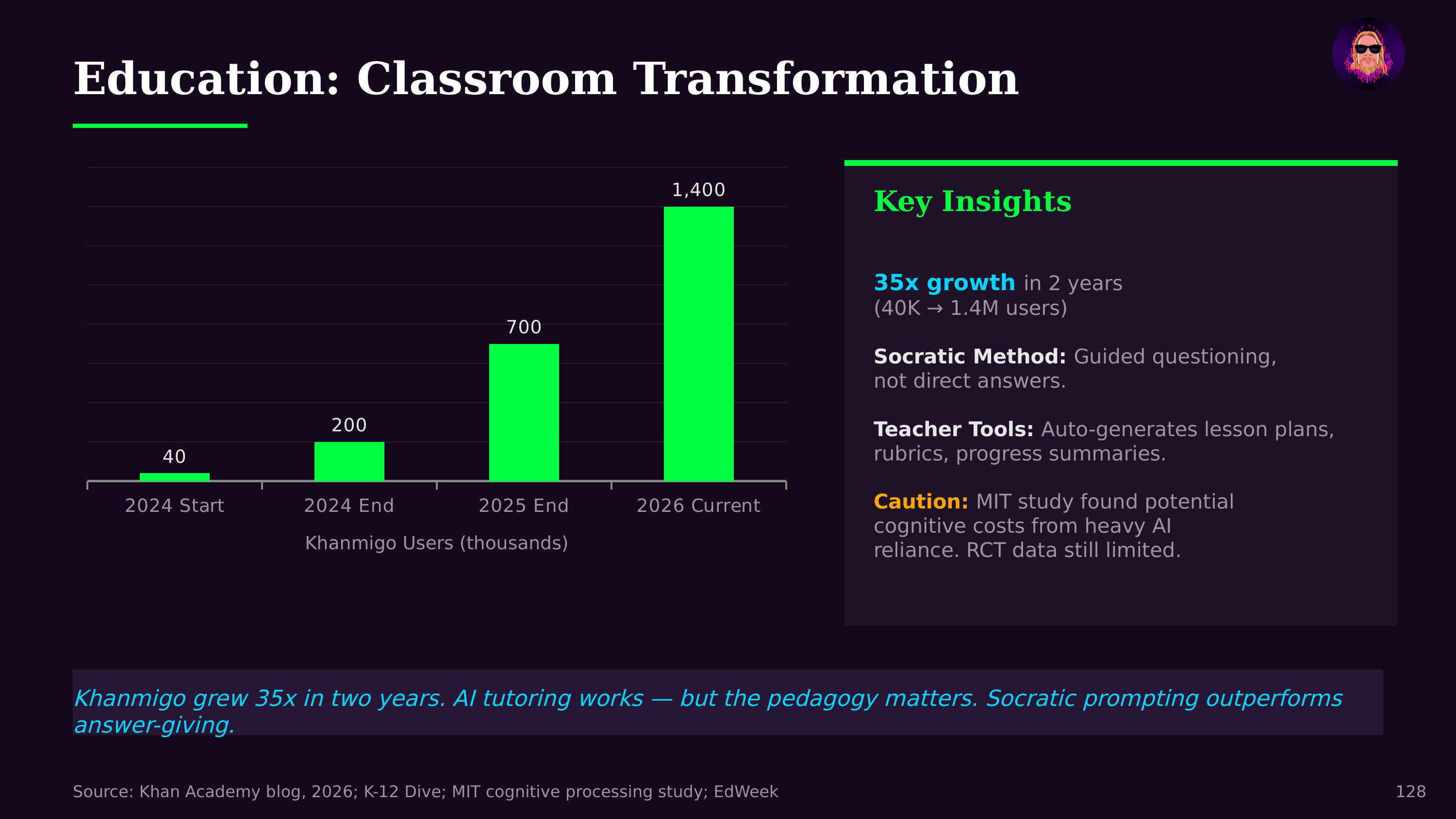
The transformation is driven by large language models capable of Socratic dialogue, step-by-step problem solving, and adaptive explanation — essentially providing every learner access to a patient, infinitely available tutor. Khan Academy's Khanmigo, powered by GPT-4, demonstrated the template: an AI that doesn't just give answers but guides students through reasoning. Duolingo Max, Google's LearnLM, and dozens of startups have followed, creating AI tutors spanning mathematics, language learning, coding, science, and professional skills.
Personalized Learning at Scale
The core promise of AI in education is personalization that was previously impossible. Traditional classrooms deliver one-size-fits-all instruction to 30 students with vastly different knowledge levels, learning speeds, and preferred modalities. AI tutors continuously assess understanding, identify knowledge gaps, adjust difficulty in real-time, and present material through whatever approach works best for each learner. A student struggling with fractions gets more visual explanations and scaffolded practice; one who grasps concepts quickly gets pushed toward higher-order challenges. This adaptive loop operates at a granularity no human teacher can match across an entire classroom.
Academic Integrity and Assessment
AI has fundamentally disrupted academic assessment. When students can generate polished essays, solve problem sets, and write code with AI assistance, traditional homework and take-home exams lose their evaluative power. Institutions have responded with a spectrum of approaches: some ban AI tools entirely, others embrace them as learning aids while redesigning assessment around oral examinations, in-class work, and process portfolios that document the student's thinking journey. AI detection tools exist but remain unreliable, creating an arms race that most educators consider unwinnable. The more productive response has been rethinking what skills matter in an AI-augmented world and assessing those instead.
Teacher Augmentation
For educators, AI serves as a force multiplier. Lesson plan generation, rubric creation, differentiated material production, and automated grading of structured assignments free teachers to focus on mentorship, motivation, and the human dimensions of education that AI cannot replicate. Early evidence suggests that AI tools are most effective when they augment teacher expertise rather than replace it — helping experienced educators scale their impact rather than substituting for pedagogical judgment.
Equity and Access
AI tutoring has profound equity implications. High-quality tutoring has historically been available only to wealthy families who can afford private instruction. AI democratizes access to patient, knowledgeable, always-available learning support. However, the digital divide means the students who most need AI tutoring may lack the devices and connectivity to access it, risking a new form of educational inequality even as AI closes old ones.