AI-Native Development
AI-Native Development describes the emerging paradigm where software is created primarily by AI systems with human direction, rather than written primarily by humans with AI assistance. This goes beyond AI code generation (autocomplete, copilots) and beyond vibe coding (natural language prompting to produce code snippets). AI-native development means entire applications — architecture, implementation, testing, deployment — are produced by AI agents operating autonomously within human-defined constraints. The human role shifts from writing code to defining intent, reviewing output, and steering direction.
The tool landscape in 2026 has matured dramatically. Cursor has become the dominant AI-native IDE, embedding frontier models directly into the editing workflow with codebase-aware context, multi-file editing, and agent-mode task execution. Windsurf (from Codeium) offers a similar model with emphasis on enterprise workflows. Anthropic's Claude Code operates as a terminal-based coding agent that can explore codebases, plan implementations, write and test code, and manage git workflows autonomously. GitHub Copilot has evolved from autocomplete to Copilot Workspace, which can take an issue description and produce a complete pull request. Devin (from Cognition) and similar fully autonomous coding agents can handle entire development tasks end-to-end.
What makes this "native" rather than "assisted" is the scope of autonomous action. An AI coding assistant suggests the next line of code. An AI-native development environment accepts a task description ("add user authentication with OAuth support, including tests and documentation") and produces a working implementation across multiple files, runs the tests, fixes any failures, and presents a completed result for human review. The model has tool use capabilities: it can read files, execute commands, run tests, search codebases, and iterate on its own output. This is agentic engineering applied to the creation of software itself.
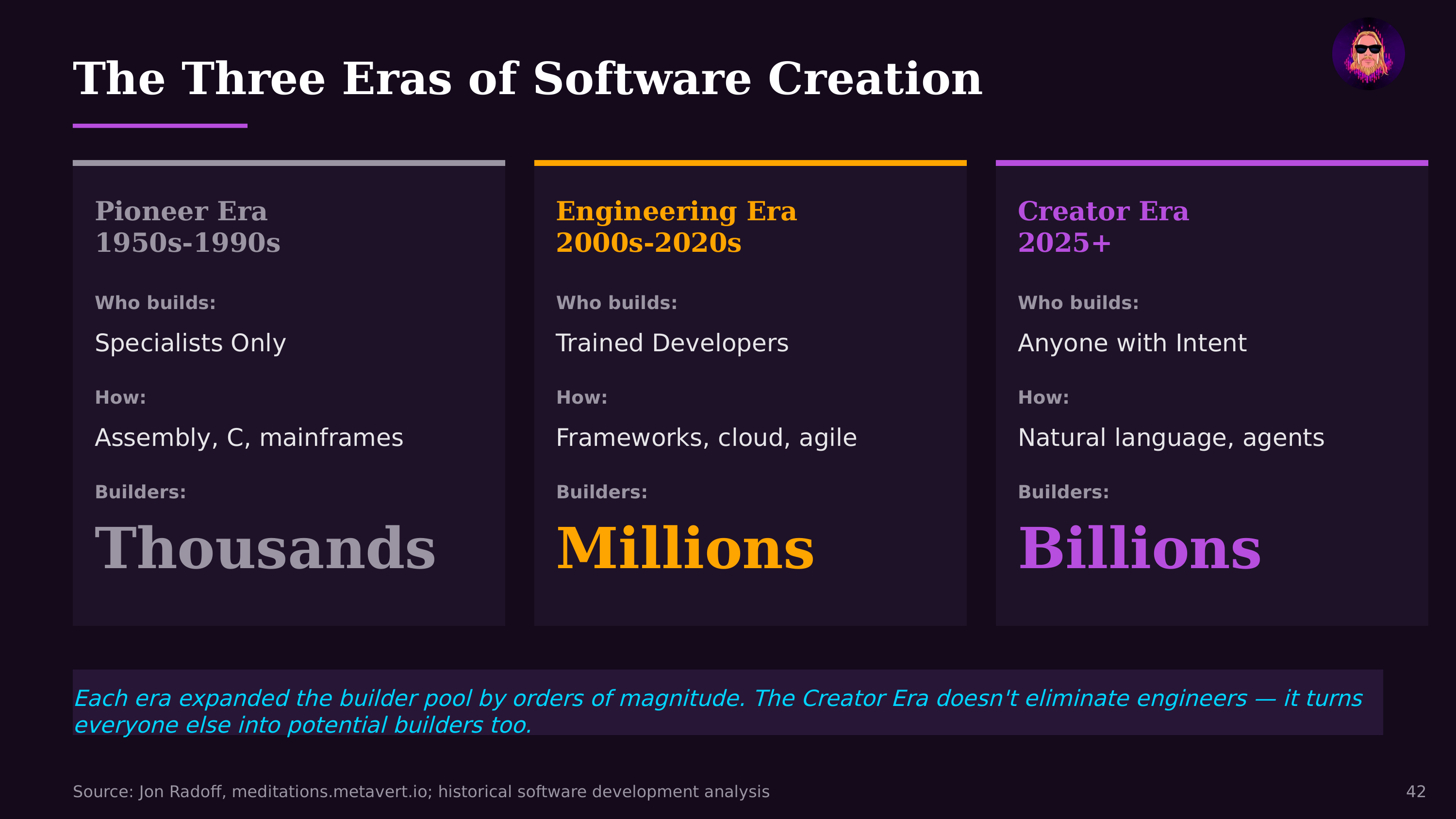
The economic implications are significant. Software development has historically been constrained by the supply of skilled developers. AI-native development doesn't eliminate the need for developers, but it dramatically amplifies their productivity — estimates range from 2x to 10x for routine development tasks. This means smaller teams can build larger systems, solo developers can create products that previously required teams, and the bottleneck shifts from "can we build it?" to "should we build it?" The creator economy implications are enormous: AI-native tools lower the barrier to software creation in the same way that YouTube lowered the barrier to video creation.
The quality question is evolving. Early AI code generation was notorious for subtle bugs, security vulnerabilities, and "works but isn't maintainable" output. 2026 AI-native tools address this through test-time compute (models that reason carefully about correctness), automated test generation and execution, and iterative refinement loops where the agent tests its own output and fixes failures. The remaining gap is in architectural judgment — choosing the right patterns, anticipating future requirements, and making tradeoffs that require deep domain understanding. This is where the human developer's role is most critical in an AI-native workflow.
Further Reading
- AI Code Generation — The predecessor paradigm
- Vibe Coding AI-Native Development — Natural language programming
- Agentic Engineering — The agent framework enabling AI-native development