Accelerando
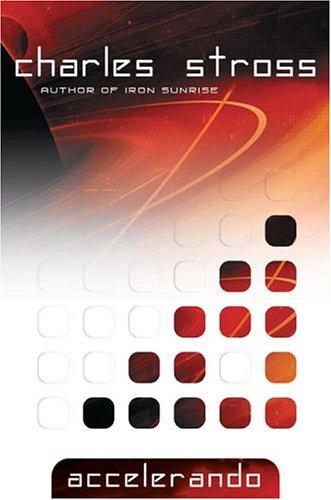
Accelerando is Charlie Stross's 2005 novel that traces three generations of the Macx family through the approach, arrival, and aftermath of a technological singularity. Originally published as nine interconnected novellas between 2001 and 2004, it remains one of the most ambitious and technically dense attempts to portray what economics, identity, and consciousness might look like on the other side of an intelligence explosion. The novel is available under a Creative Commons license, which is itself a statement about the post-scarcity information economy it depicts.
The first third follows Manfred Macx, a venture altruist who gives away ideas instead of selling them, sustaining himself through a reputation economy and a constellation of AI-assisted agents that manage his affairs. Manfred doesn't work in any traditional sense — he generates intellectual property, releases it into the commons, and lives off the reciprocal goodwill and attention this generates. His wearable computing glasses (written in 2001, years before Google Glass) serve as an external prosthetic for his memory and cognition. This vision of an agentic economy — where AI agents negotiate, transact, and optimize on behalf of humans — is remarkably close to the trajectory of AI agent development in 2025-2026. Stross anticipated that the bottleneck wouldn't be intelligence but attention, and that agents would be necessary to manage the flood.
The second third follows Amber, Manfred's daughter, who uploads her consciousness into a spacecraft-bound simulation to explore a router network left by a post-biological alien civilization. Here Stross confronts the central question of digital identity: if you can fork yourself into multiple copies, which one is "you"? The uploaded Amber negotiates trade agreements with alien intelligences while her biological original remains in the solar system — raising questions about digital identity, legal personhood, and the economics of consciousness that connect directly to ongoing debates about AI rights and virtual beings. The alien routers themselves represent a galaxy-scale internet of post-biological civilizations that have transcended their original substrates — a vision that extends Stapledon's cosmic perspective into the network age.
The third act portrays the aftermath of the Singularity. The inner solar system has been dismantled and converted into a Matrioshka brain — nested Dyson spheres running incomprehensible post-human intelligences. Sirhan, Manfred's grandson, lives in a deliberately retro human community on a cometary habitat at the edge of the solar system, trying to preserve human-scale existence in the face of transcendence. The Economics 2.0 system that governs the post-Singularity economy is fundamentally alien — a market where the agents themselves evolve, where intellectual property is generated and consumed faster than any human can track, and where "the ends justify the means" has been replaced by an optimization landscape that no single intelligence can comprehend.
Stross's treatment of intellectual property is especially relevant to the creator economy. The novel portrays a world where the concept of IP ownership breaks down under the pressure of exponentially accelerating innovation. When ideas can be generated, combined, and deployed faster than legal systems can adjudicate ownership, the entire framework of patents and copyrights becomes an impediment. Manfred's venture altruism — creating value by giving things away — mirrors the open-source movement and connects to current debates about AI-generated content, training data rights, and the future of creative ownership.
Cluster topics relevant to metavert.io: Accelerando connects to an extraordinary range of themes on this site. The reputation economy and agentic agents anticipate agentic commerce and the creator economy. The consciousness uploads connect to digital identity and virtual beings. The Matrioshka brain extends the Dyson Sphere and Dyson Swarm concepts. The IP debates anticipate generative AI copyright conflicts. Stross's work is unique in treating the Singularity not as a rapture but as an economic phase transition — which makes it particularly relevant to anyone thinking about the practical implications of accelerating AI.
Further Reading
- Accelerando — Charlie Stross (2005)
- Accelerando (free CC edition) — Charlie Stross
- Charlie Stross — Author profile on metavert.io