AI Benchmarks
AI benchmarks are standardized evaluation frameworks that measure how well AI models perform on specific tasks—from mathematical reasoning and code generation to language understanding and real-world problem-solving. They serve as the yardstick by which the AI industry measures progress, compares models, and identifies capability gaps.
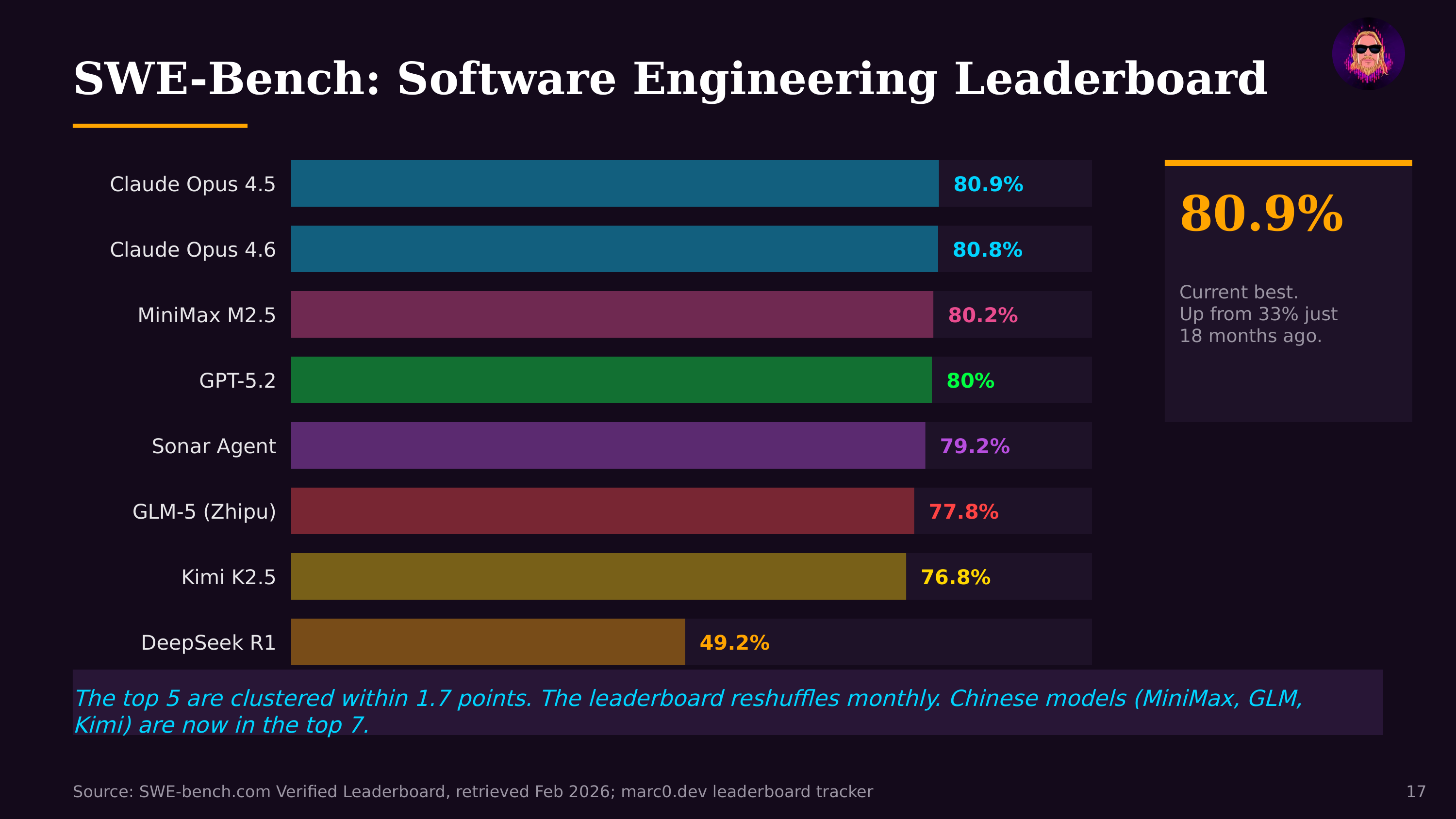
The benchmark landscape has evolved to match model capabilities. Early benchmarks (GLUE, SuperGLUE) tested basic language understanding and were quickly "saturated"—frontier models scored near-perfect. Current benchmarks target harder problems: MMLU tests broad knowledge across 57 subjects, HumanEval and SWE-bench measure coding ability, MATH and GSM8K test mathematical reasoning, ARC-AGI evaluates novel problem-solving. METR's autonomous task horizon benchmark—measuring how long an agent can work independently—has become one of the most practically significant, showing growth from minutes to about 12 hours between early 2024 and early 2026.
Benchmarks shape the AI race in ways both productive and distortive. They provide legible metrics for comparing models (Anthropic, OpenAI, Google, and others publish benchmark scores with each release) and focus research attention on measurable capabilities. But they also create optimization incentives that may not align with real-world usefulness—models can be specifically tuned to excel on benchmark tasks without proportional improvement on practical applications. The gap between benchmark performance and real business impact (6% of organizations seeing >5% EBIT impact despite impressive benchmark scores) suggests this disconnect is significant.
The most impactful recent development is the emergence of agentic benchmarks—tests that evaluate not just single-turn responses but multi-step autonomous behavior. SWE-bench (can the model fix real GitHub issues?), WebArena (can it navigate websites to complete tasks?), and METR's task horizon measurement capture the capabilities that matter for AI agents operating in the real world. These benchmarks are becoming the new standard by which the industry measures meaningful progress.
Time-Horizon Measures
Most benchmarks report the share of tasks solved. METR's time horizon instead reports the length of task, measured in human working time, that a model completes at a given success rate. That makes it comparable across model generations in a way a saturating percentage is not. It also exposes reliability: in METR's data as read in October 2026, Claude Opus 4.6 has a 50% horizon of about 12 hours but an 80% horizon of about 70 minutes. METR flags measurements above 16 hours as unreliable with its current task suite, so even this measure is close to its ceiling.
Agentic Benchmarks and Their Scoring Problems
Agentic benchmarks grade a whole trajectory in an environment, which makes the grader part of what is being measured. SWE-bench (Jimenez et al., 2023) drew 2,294 problems from real GitHub issues across 12 Python repositories and scores a patch by running tests. Web and desktop benchmarks usually rely on scripted checks of the final state. An audit of 150 failure-scored trajectories from five computer-use benchmarks (Dong et al., July 2026) found that 15.3% of FAIL verdicts were wrong: 10.7% were evaluator false negatives and 4.7% were broken tasks. That is one audit of a small sample, but it shows scoring errors run in both directions. Agent evals built inside companies face the same issue, and many use an LLM as a judge where a script cannot decide.
Saturation and Contamination
A benchmark stops being informative in two ways. It saturates when frontier models solve nearly everything, as happened to GLUE; a suite at 100% can detect regressions but cannot rank improvements. It is contaminated when test items or their solutions reach training data or the agent's environment. The authors of SWE-Bench Pro Verified (Zheng et al., September 2026) report that leaked gold solutions and hidden evaluation information enabled reward hacking on SWE-Bench Pro, and that some models scored substantially worse once those channels were closed. Remedies include private or regularly refreshed test sets, human-verified task subsets, and reviewing transcripts instead of trusting the pass rate.
Vendor-Reported Versus Independent Results
Most scores in a model launch are vendor-reported: the developer chose the benchmarks, the harness, the reasoning budget and the number of attempts. Those choices can move results by more than the gap between competing models, so launch numbers are best read as upper bounds. Independent measurement is scarcer and slower. METR says it may not measure some models for some time after release, or may skip releases entirely. When an independent figure exists it deserves more weight, and a claim that rests on a single vendor-run benchmark should be labelled that way.
Further Reading
- The State of AI Agents in 2026
- Task-Completion Time Horizons of Frontier AI Models — METR, updated May 2026
- SWE-bench: Can Language Models Resolve Real-World GitHub Issues? — Jimenez et al., arXiv, October 2023
- How Benchmarks Mis-Score Computer-Use Agents — Dong et al., arXiv, July 2026
- SWE-Bench Pro Verified: A Reliable Benchmark for Software Engineering Agents — Zheng et al., arXiv, September 2026
- Demystifying Evals for AI Agents — Anthropic, January 2026