Halting State
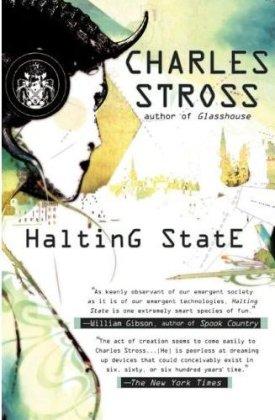
Halting State is Charlie Stross's 2007 novel about a bank robbery that takes place inside a massively multiplayer online game. A band of orcs, backed by a dragon, raids the central bank of the fictional MMO Avalon Four and steals a fortune in virtual assets. This sounds like a prank — until it becomes clear that the virtual assets have real monetary value, the theft is connected to state-level espionage, and the insurance claim that follows triggers a criminal investigation under Scottish law. The novel, written entirely in second person, is both a procedural thriller and one of the sharpest explorations of what happens when virtual economies become indistinguishable from real ones.
The central premise — that crimes inside virtual worlds are real crimes — was considered speculative in 2007. It is now unremarkable. In 2012, the FBI shut down Liberty Reserve for laundering $6 billion through virtual currency. In 2022, the U.S. Treasury sanctioned Tornado Cash, a cryptocurrency mixer, treating smart contract code as a sanctionable entity. South Korea has prosecuted theft of virtual items since the mid-2000s. The European Union's Markets in Crypto-Assets regulation treats virtual assets as financial instruments. Stross didn't just predict this — he worked through the jurisdictional, evidentiary, and philosophical complications that real-world regulators are still sorting out. If virtual property has value and can be stolen, then virtual spaces require governance, law enforcement, and property rights frameworks — which is precisely the trajectory of virtual world regulation today.
The novel's depiction of augmented reality policing is striking. Police officers use AR overlays to see real-time information about suspects, access criminal databases through their field of vision, and coordinate through spatial computing interfaces. Crime scenes are documented in 3D and replayed as immersive reconstructions. The technology described in 2007 — persistent AR displays, spatial data overlays, real-time identity verification — maps almost exactly to current law enforcement interest in AR headsets, body cameras with AI analysis, and predictive policing systems. The privacy implications that Stross raises — constant surveillance, identity tracking, the erosion of anonymity in public space — connect directly to debates about social credit systems and differential privacy.
Stross's treatment of the game company Hayek Associates is a pointed satire of virtual world governance. The company runs multiple MMOs that function as economic sandboxes, each testing different economic theories. The company name references Friedrich Hayek, the libertarian economist, and the games themselves become laboratories for spontaneous order, market dynamics, and emergent governance — exactly the role that blockchain-based virtual economies and DAOs would later attempt to play. The fact that a state intelligence agency infiltrates these games to exploit their economic infrastructure for espionage purposes illustrates how virtual economies can become vectors for real geopolitical conflict.
The jurisdictional complexity is the novel's quiet masterpiece. Scotland (where the novel is set) has its own legal system within the UK. The game is operated by a company based in one jurisdiction, with servers in another, players worldwide, and virtual assets whose legal status varies by country. The theft occurs in a virtual space that doesn't exist in any physical location. Which law applies? Which police force has authority? This is not a hypothetical problem — it is the defining challenge of virtual world governance, blockchain regulation, and cross-border digital crime that regulators grapple with daily.
Cluster topics relevant to metavert.io: Halting State is essential reading for anyone interested in the governance and economics of virtual worlds. The virtual economy framework connects to virtual worlds, the creator economy, and blockchain-based asset systems. The AR policing connects to spatial computing, social credit, and surveillance technology. The jurisdictional themes anticipate interoperability challenges and platform governance debates. Stross wrote a sequel, Rule 34 (2011), that extends these themes into algorithmic policing and spam-as-crime, but Halting State remains the more foundational text for metaverse governance.
Further Reading
- Halting State — Charlie Stross (2007)
- Charlie Stross — Author profile on metavert.io
- Blockchain — Virtual economies and digital assets