Rainbows End
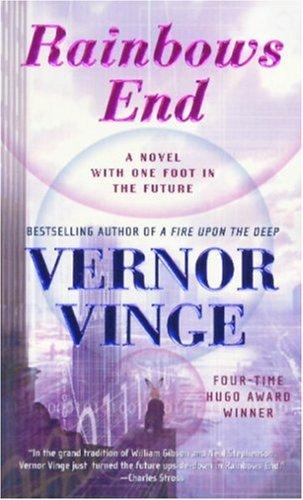
Rainbows End is Vernor Vinge's 2006 Hugo Award-winning novel set in the near future of 2025 — a date that has now passed, making it one of the most interesting science fiction novels to evaluate against the reality it predicted. The book envisions a world where augmented reality has become the default interface layer for human experience. People wear contact lenses and clothing embedded with sensors and displays that overlay digital information onto physical reality. The internet is no longer something you visit on a screen — it is woven into the fabric of the world itself.
The core technological vision is what makes Rainbows End prophetic. Vinge imagines that augmented reality replaces the smartphone, the laptop, and the television. People gesture in the air to manipulate data. Buildings are "skinned" with digital overlays that change depending on the viewer — one person sees a Gothic cathedral, another sees a Japanese garden, a third sees the bare concrete underneath. Physical spaces become canvases for competing aesthetic visions, and the act of choosing which reality layer to inhabit becomes a statement of identity and allegiance. This concept — that AR doesn't just add information to reality but fundamentally replaces it with personalized alternatives — goes further than most current AR visions and connects directly to spatial computing and the concept of persistent virtual worlds overlaid on physical space.
"Belief circles" are Vinge's term for affinity groups — communities of people who share the same AR overlay, the same curated information environment, the same aesthetic skin on reality. Published in 2006, this was a remarkably prescient prediction of filter bubbles, algorithmic echo chambers, and the political polarization that would come to define social media in the 2010s and 2020s. But Vinge takes it further: in Rainbows End, your belief circle literally determines what you see. Two people standing in the same room perceive entirely different environments. The epistemological implications — that shared physical space no longer guarantees shared experience — anticipate the fragmentation of consensus reality that now manifests through algorithmic curation and generative AI.
The digitization of the UCSD library is one of the novel's central plot points. The university library is being physically destroyed — books shredded — in order to digitize their contents at industrial speed. This provokes a revolt among those who value physical books, but the larger point is about the transformation of human knowledge from atoms to bits, and the power that comes from controlling that process. Google Books launched its mass-digitization project in 2004, two years before the novel's publication, and the resulting legal battles over copyright, access, and control of digitized knowledge played out almost exactly as Vinge implied. The question of who controls the digitized commons connects to current debates about AI training data, copyright, and the agentic web's relationship to content creators.
The novel's treatment of wearable computing deserves attention. Vinge's characters are not wearing bulky headsets — they wear ordinary-looking clothes with embedded computation, and contact lenses that serve as displays. The gap between this vision and current hardware (Apple Vision Pro, Meta Quest, various smart glasses) illustrates how far the form factor still needs to evolve. But the behavioral patterns Vinge describes — constant ambient computing, gesture-based interfaces, social norms around when it's rude to be "wearing" — are increasingly visible in early adopter communities today.
Rainbows End connects to nearly every spatial computing and AR theme. The belief circles concept anticipates filter bubbles and connects to discussions of social credit and algorithmic governance. The library digitization plot connects to content authenticity and the provenance of digital information. Vinge's broader work on the Singularity provides the theoretical backdrop — Rainbows End is set in the approaching shadow of a technological singularity that the characters can feel but not yet see.
Further Reading
- Rainbows End — Vernor Vinge (2006)
- Vernor Vinge — Author profile on metavert.io
- The Singularity — Vinge's foundational concept