Daemon (Daniel Suarez)
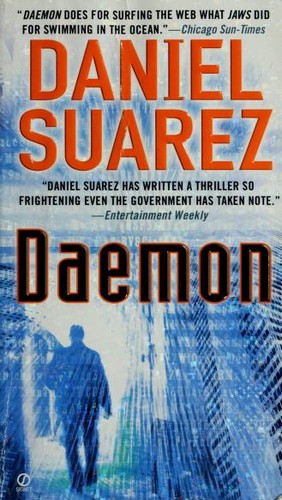
Daemon (2006) and its sequel Freedom™ (2010) by Daniel Suarez are techno-thrillers that have become required reading in Silicon Valley for their eerily prescient depiction of autonomous software agents reshaping the physical world. The premise: a legendary game designer dies and activates a distributed, persistent AI program — a daemon — that begins autonomously recruiting humans, coordinating resources, and building an alternative economic and governance system, all without any human operator.
What makes Suarez's vision distinctive is its technical specificity. The daemon doesn't achieve consciousness or become superintelligent. It operates through existing technology — automated trading, social media manipulation, drone coordination, encrypted communications, and game-like incentive structures — to reorganize human behavior at scale. This is far more realistic than most AI fiction: it's not Skynet, it's a distributed agentic system that treats the real world as a massively multiplayer game. Suarez, himself a systems consultant and software developer, builds the daemon from real technologies, which is why the novels read less like fiction and more like a near-future operations manual.
Cluster topics relevant to metavert.io include: Autonomous agents and distributed systems — the daemon is the most compelling fictional depiction of what happens when AI agents operate persistently and autonomously in the real world, coordinating through multi-agent architectures without centralized control. It prefigured the entire agentic AI paradigm by nearly two decades. Game-layer economics and incentive design — the daemon uses game economy mechanics (reputation scores, quests, leveling systems, resource allocation) to organize human labor and governance. This directly anticipates the gamification movement, DePIN networks, and crypto-economic coordination mechanisms. Decentralized governance — Freedom™ depicts the daemon's mature system as a post-corporate, decentralized society organized by darknet networks — a vision that resonates with both the DAO movement and critiques of platform monopolies.
Suarez's broader corpus extends these themes. Kill Decision (2012) tackled autonomous weapons and drone swarms. Delta-v (2019) and Critical Mass (2023) explore asteroid mining and space industrialization. But Daemon remains his most influential work because it identified the pattern that defines the 2020s: AI doesn't need to be smarter than humans to transform civilization — it just needs to be persistent, distributed, and operating at a scale no human organization can match.
Further Reading
- The State of AI Agents in 2026 — Jon Radoff