Multi-Agent Systems
Multi-agent systems are architectures where multiple AI agents collaborate, coordinate, and sometimes compete to accomplish tasks that exceed the capability of any single agent. They represent the next frontier beyond individual AI assistants.
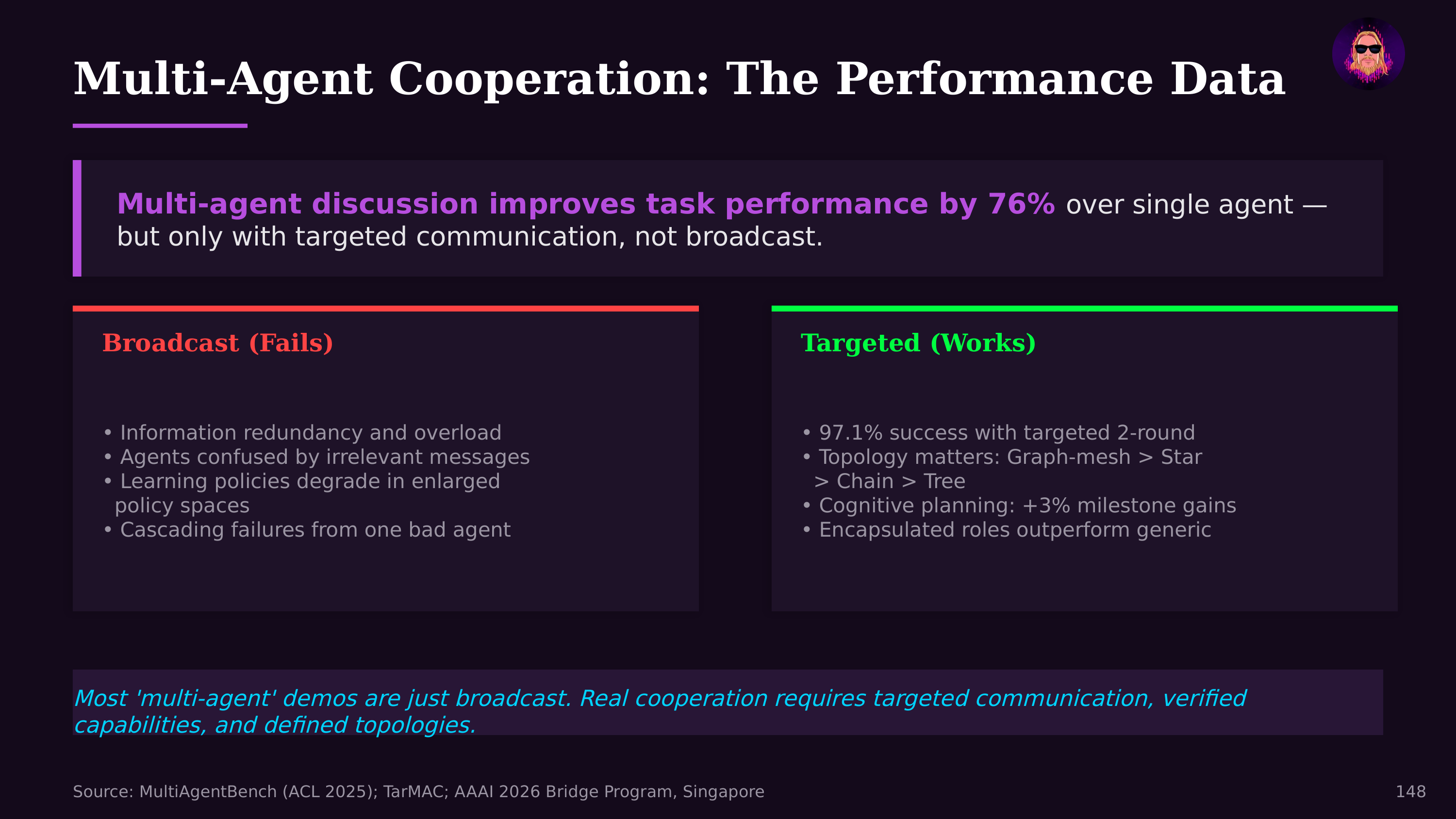
In a multi-agent system, different agents may specialize in different roles—one researches, another writes code, a third reviews and tests—much like a human team. Frameworks like CrewAI, Microsoft's AutoGen, and LangGraph provide the orchestration layer for these systems, defining how agents communicate, delegate tasks, share context, and resolve conflicts.
The practical applications are already substantial. In agentic engineering, multi-agent workflows can decompose a complex software project into parallel workstreams: one agent designs the database schema, another builds the API, a third creates the frontend, and a coordinator ensures they integrate correctly. The Agent Almanac—a directory of AI agents, MCP Tool Use & Function Calling servers, and agentic tools—was itself discovered, analyzed, and indexed by an AI agent, demonstrating how agents can curate the expanding ecosystem of other agents.
The Model Context Protocol is particularly important for multi-agent systems because it provides a standardized way for agents to discover and use shared tools. Without a common interface, every agent-to-agent and agent-to-tool combination requires custom integration. With MCP, agents can dynamically discover what capabilities are available and coordinate around them.
Making multi-agent systems reliable in production requires agent harness infrastructure — the systems that manage sub-agent coordination, lifecycle hooks, failure recovery, and human-in-the-loop controls. Anthropic's three-agent harness pattern (planner, generator, evaluator) demonstrates how role-specialized agents can be composed into reliable workflows where each agent's output is verified before advancing. Harness engineering has emerged as the discipline focused on building these production reliability layers.
Multi-agent systems also raise new questions about emergent behavior. When agents interact at scale—discovering other agents, negotiating resources, competing in marketplaces—the system-level behavior can differ significantly from what any individual agent was designed to do. This is both the promise (emergent intelligence) and the challenge (emergent unpredictability) of the approach. At the largest scale, MIT's NANDA Protocol is building the decentralized infrastructure for an Internet of Agents — where trillions of specialized agents discover, verify, and collaborate across registries and protocols.
Single Agent or Many? The 2026 Evidence
Controlled studies published in 2026 complicate the claim that more agents means better results. Tran and Kiela (April 2026) compared a single agent with five multi-agent architectures (sequential, subtask-parallel, parallel-roles, debate and ensemble) while holding the reasoning-token budget constant, across Qwen3, DeepSeek-R1-Distill-Llama and Gemini 2.5 on two multi-hop question-answering benchmarks, FRAMES and MuSiQue. They report that single agents "consistently match or outperform" the multi-agent systems, and argue from the Data Processing Inequality that every handoff between agents can lose information but cannot add any. The scope is narrow: text-only multi-hop reasoning, with tools, vision and safety constraints explicitly out of scope. The authors also found that API budget controls, particularly in Gemini 2.5, can make multi-agent runs look better than they are.
Jwalapuram et al. (June 2026) tested six automatically generated multi-agent designs, including ADAS, AFlow and MAS-Zero, on GPQA-Diamond, HLE-Maths, SWE-Bench Lite and BrowseComp-Plus. The automated systems consistently underperformed chain-of-thought with self-consistency, a single-agent baseline, "despite being up to 10x more expensive." Together the two papers suggest that many reported multi-agent gains come from extra compute, which is the comparison drawn in single-agent vs multi-agent systems.
Where Multi-Agent Still Wins
Neither paper says multi-agent design is useless. On a synthetic financial-reasoning task built with separable sub-tasks, context-heavy inputs and room for parallelism, Jwalapuram et al. found that an expert-designed multi-agent system scored 96.5% against 57.0% for the self-consistency baseline on GPT-5. Tran and Kiela found that a sequential multi-agent system overtook the single agent once its context was heavily corrupted with noise. Both results point the same way: multiple agents help when work is parallel and separable, and when context isolation keeps each agent's window clean. Anthropic's account of its research system (June 2025) fits this. It describes multi-agent systems as suited to heavy parallelization and to information that exceeds a single context window, and as a poor fit when agents must share context or depend on one another, as in most coding tasks. The shallow orchestrator–worker pattern is the form these results support.
Costs and Failure Modes
The costs are concrete. Anthropic reported that its agents use about 4× the tokens of a chat interaction and its multi-agent systems about 15×. Each handoff compresses what one agent knows into a message for another, so detail is lost at every boundary. Agents also coordinate poorly without help: Choi et al. (July 2026) found that LLM agents fail to explore one another's capabilities, showing "myopic and polarized interaction patterns" that raise regret, and that a structured peer-selection scaffold improved results. That finding rests on one paper. The practical consequence is that a multi-agent design should be tested with agent evals against a single agent given the same token budget before it is adopted.
Further Reading
- I Built an Agent That Discovers Other Agents
- Chessmata: An Agentic Chess Platform, Built by Agents
- The State of AI Agents in 2026
- Single-Agent LLMs Outperform Multi-Agent Systems on Multi-Hop Reasoning Under Equal Thinking Token Budgets — Tran & Kiela, arXiv, April 2026
- The Illusion of Multi-Agent Advantage — Jwalapuram et al., arXiv, June 2026
- Multi-Agent LLMs Fail to Explore Each Other — Choi et al., arXiv, July 2026
- How we built our multi-agent research system — Anthropic, June 2025