Vibe Coding
Vibe coding is the practice of building software by describing what you want in natural language and letting AI agents write the actual code—embracing the "vibe" of the intended outcome rather than specifying every technical detail. The term was coined by Andrej Karpathy (former Tesla AI lead and OpenAI researcher) in early 2025 and quickly became shorthand for a fundamental shift in how software gets built.
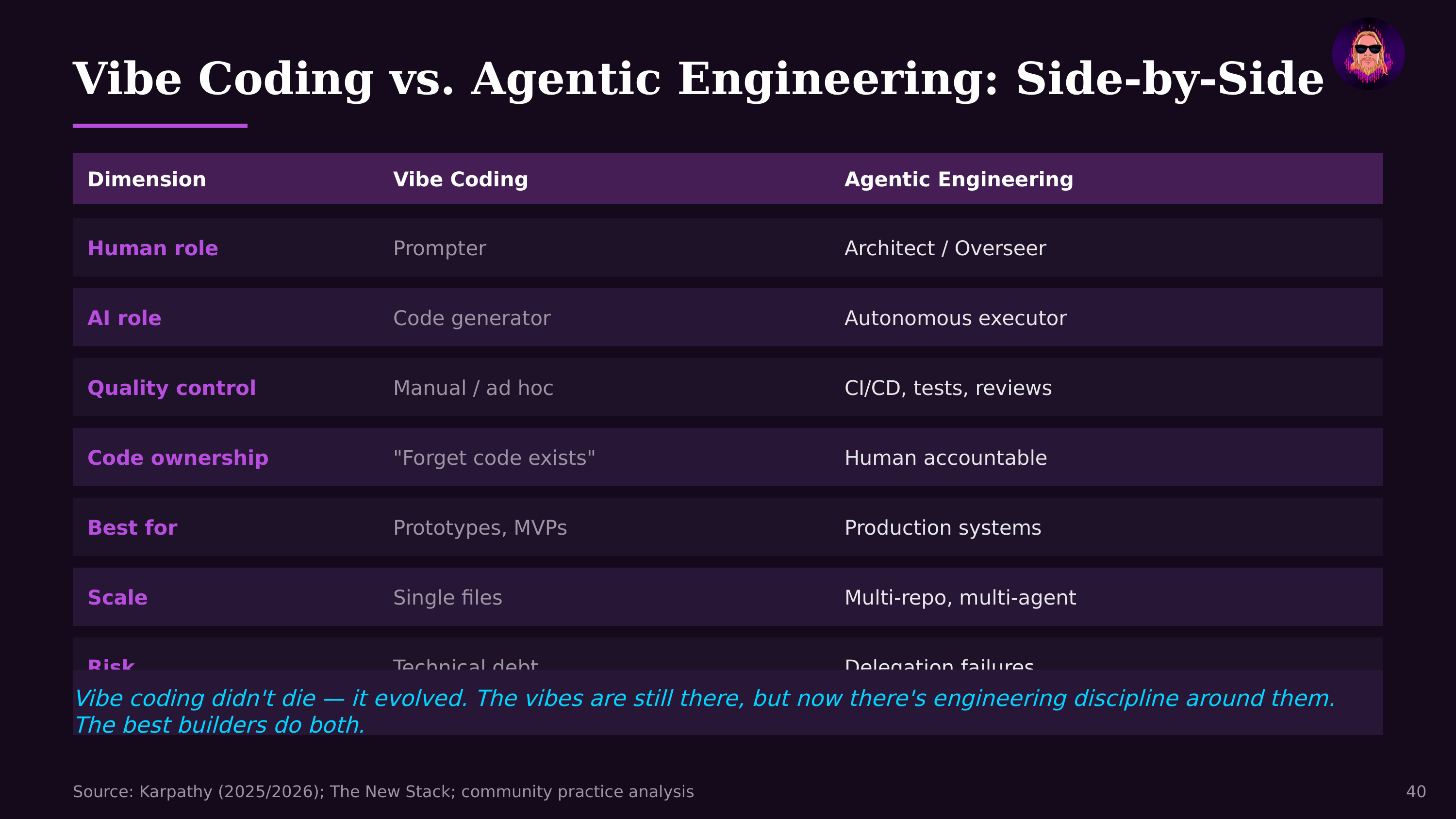
Karpathy's description was characteristically precise: you describe the feature you want, the AI generates code, you run it, see what happens, and iterate. You might not fully understand every line of code the AI produces—and that's the point. The skill shifts from writing code to evaluating outcomes, guiding direction, and knowing when to accept or push back on the AI's approach. It's programming by intent rather than by instruction.
The tools enabling vibe coding have matured rapidly. AI code editors like Cursor, Windsurf, and GitHub Copilot embed LLM-powered agents directly in the development environment. Claude Code, Aider, and similar CLI tools let developers delegate entire implementation tasks. The merged PRs per engineer metric at Anthropic increased 67% after introducing Claude Code—a quantitative measure of how much vibe coding accelerates professional development.
Vibe coding is the practical expression of agentic engineering. It's why the Creator Era is possible: when building a multiplayer chess platform over a weekend (as with Chessmata) or creating a full CMS with AI-native workflows, the developer is vibe coding—articulating vision and letting AI handle implementation details. Critics worry about code quality and technical debt. Proponents argue that the speed advantage is so dramatic that even imperfect AI-generated code, iterated rapidly, outperforms slow, hand-crafted code for most applications. The top-quartile AI users seeing 6x productivity improvements aren't writing more code—they're vibe coding better.