Altered Carbon
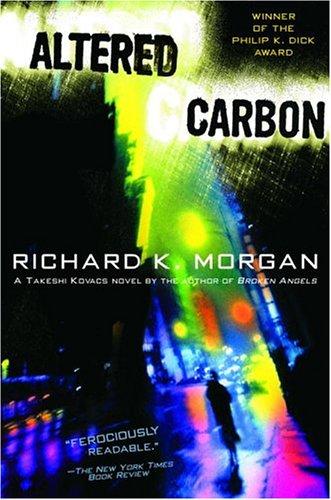
Altered Carbon (2002) by Richard K. Morgan is a cyberpunk noir novel set in a future where human consciousness can be digitized and stored on a "cortical stack" implanted at the base of the skull. Bodies become "sleeves": interchangeable, upgradable, disposable. Death becomes a temporary inconvenience for those who can afford backup storage, and permanent oblivion for those who can't. It is the most visceral fictional exploration of what happens when transhumanist technology arrives but capitalism doesn't change.
The Netflix Adaptation
Netflix adapted Altered Carbon into a two-season television series (2018–2020), with Joel Kinnaman starring as Takeshi Kovacs in Season 1 and Anthony Mackie in Season 2 — the casting change itself reinforcing the novel's central conceit that identity persists across different bodies. The show brought Morgan's stack-and-sleeve technology to visual life: viewers watched characters re-sleeved into unfamiliar bodies, experienced virtual reality torture chambers where time dilation makes minutes feel like years, and saw the Meths' orbital residences towering above a neon-drenched Bay City. The series expanded the worldbuilding with AI-managed hotels (Poe, an AI modeled on Edgar Allan Poe, runs The Raven hotel), adding a layer of AI assistant characterization that the novel only implied. While Season 2 diverged significantly from the source material and the series was not renewed for a third season, the adaptation succeeded in making stack technology feel tangible rather than theoretical — and introduced Morgan's ideas to a global audience of millions who may never have encountered the novels.
Digital Consciousness & the Economics of Immortality
The technology's implications are Morgan's real subject. Stack technology means the ultra-wealthy ("Meths," short for Methuselahs) have lived for centuries, accumulating power and wealth across multiple lifetimes, inhabiting custom-grown designer bodies. The poor can be "re-sleeved" into whatever body is available — often one of a different age, sex, or ethnicity than their own. Criminals are punished by having their stacks put in storage ("on ice"), their bodies rented out. Murder becomes a property crime unless you destroy the stack. Altered Carbon takes Permutation City's philosophical inquiry about uploaded minds and grounds it in class warfare. The stack is consciousness-as-data, but unlike Egan's egalitarian computational universe, Morgan shows how existing power structures would weaponize digital immortality. This connects directly to debates about who benefits from longevity technology and AI-augmented cognition.
Identity, Embodiment & Virtual Existence
Characters experience "sleeve sickness" when transferred to unfamiliar bodies, and can be "double-sleeved" (two copies running simultaneously, which is illegal). The novel — and the Netflix adaptation's visual treatment of re-sleeving — treats digital human identity as inherently unstable and embodiment as psychologically essential. This is a counterpoint to purely digital visions of the metaverse: even when consciousness is software, the body still matters. The show's VR interrogation sequences, where characters are tortured in simulated environments with manipulated time perception, connect directly to questions about consciousness, suffering, and moral status in virtual worlds.
Surveillance, Power & Inequality
Morgan's world is one where technology amplifies existing inequalities rather than dissolving them — a critique that applies directly to AI's current trajectory. Governance questions about who controls AI systems, who benefits from them, and who bears their costs are the novel's central concerns rendered in narrative form. The Meths' centuries of compounded wealth and political influence represent the logical endpoint of technological advantage without redistributive governance — a scenario that resonates with contemporary debates about AI concentration and the risks of transformative technologies controlled by narrow interests.
Morgan wrote two sequels (Broken Angels, Woken Furies) that expand the universe into military science fiction and alien archaeology, but the original novel's core insight endures: the question isn't whether we can digitize consciousness, but what kind of society we build around the ability to do so.