Permutation City
Permutation City (1994) is a novel by Australian science fiction author Greg Egan that remains the most rigorous fictional exploration of what happens when consciousness can be digitized, copied, and run as software. It asks the questions that the AI and transhumanism communities are only now beginning to confront: If you can copy a mind, which copy is "you"? If a simulation is sufficiently detailed, is it real? What are the economics and ethics of digital immortality?
The novel's central premise is the "Dust Theory" — the idea that any sufficiently complex pattern that could exist does exist, and that consciousness is substrate-independent: it doesn't matter whether a mind runs on biological neurons, silicon chips, or pure mathematics. Characters in Permutation City run as "Copies" — uploaded human minds executing in simulated environments. Wealthy Copies run at high speed in rich environments; poor Copies run slowly in degraded simulations. The novel's protagonist discovers a way to create an entirely self-sustaining universe from scratch, one that doesn't depend on external hardware at all — a simulation so complete it becomes its own reality.
The relevance to contemporary AI is profound. Large language models have reignited the debate about whether sophisticated information processing constitutes consciousness. Egan doesn't hand-wave this — he engages with it mathematically. Permutation City treats mind uploading as an engineering problem with specific computational costs, bandwidth requirements, and fidelity tradeoffs, making it the hardest of hard science fiction on the topic. The novel's economic structure — where computational resources determine quality of life for digital beings — maps directly onto current debates about AI compute costs and datacenter capacity.
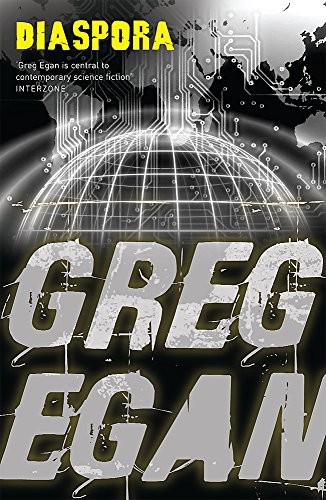
Egan's broader corpus extends these ideas. Diaspora (1997) follows civilizations of uploaded minds spanning millennia. Schild's Ladder (2002) depicts entities operating at the Planck scale of physics. His short fiction, particularly "Learning to Be Me" (about a neural implant that gradually replaces biological consciousness) and "Reasons to Be Cheerful" (about engineering subjective experience), explores AI consciousness from angles that Philip K. Dick approached intuitively but Egan approaches with mathematical precision.
Egan provides the most rigorous fictional framework for evaluating whether simulated minds are "real" — directly relevant to debates about AI sentience and the simulation hypothesis. The resource constraints on his Copies map to the metaverse's fundamental question: who pays for the compute that sustains digital existence? And when minds can be forked, merged, and versioned, traditional concepts of identity dissolve entirely, connecting to questions about digital ownership, AI agent persistence, and what it means to maintain continuity in a copyable world.
Further Reading
- The State of AI Agents in 2026 — Jon Radoff