Open-Weight Models
Open-weight models are AI systems whose trained neural network parameters (weights) are released publicly, allowing anyone to download, run, and often fine-tune them—while the training data, training code, or commercial use rights may remain restricted. This distinction from fully open-source AI matters more than most people realize.
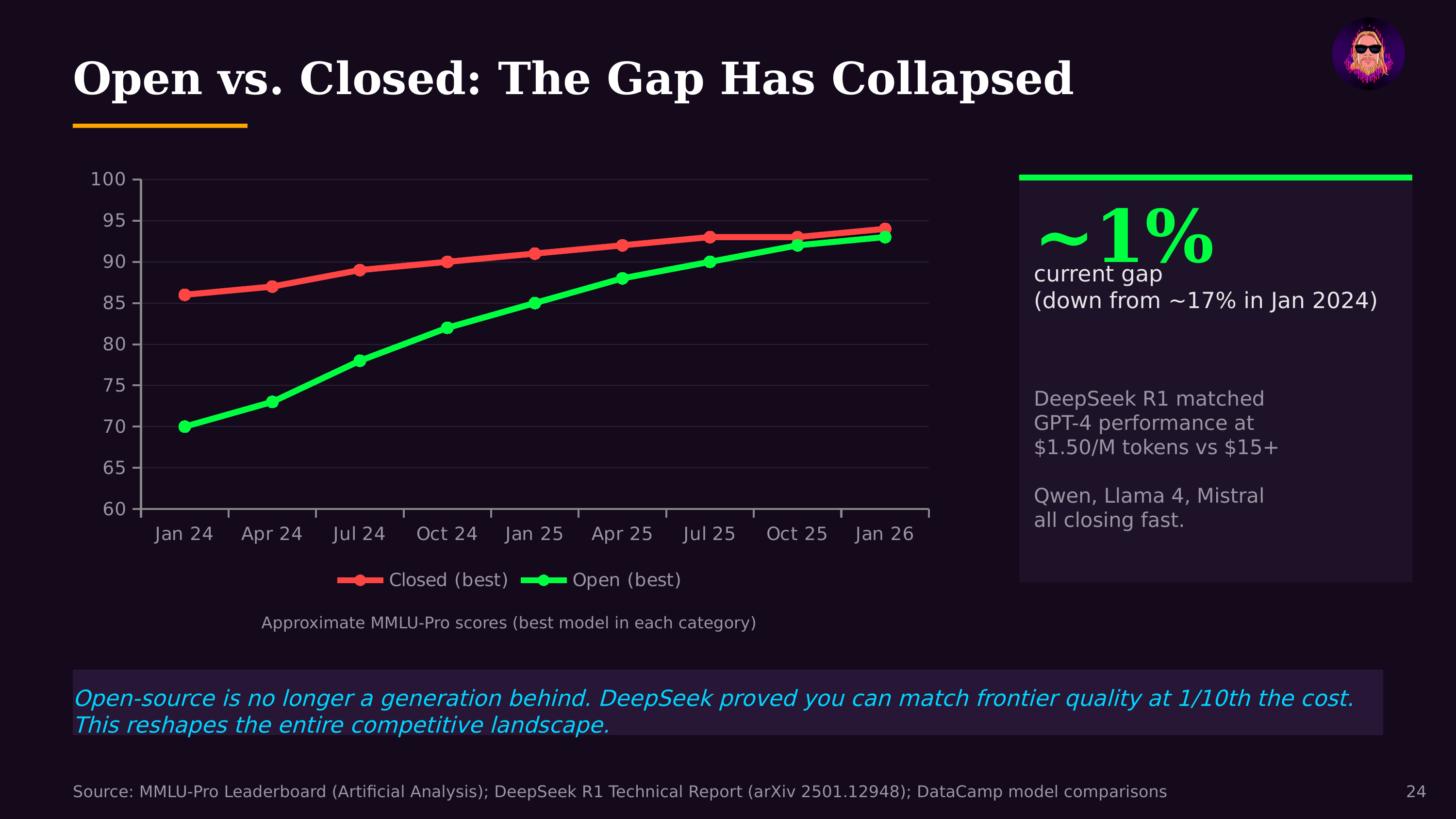
The term gained precision as the AI industry grappled with what "open" actually means. Meta's Llama models, for instance, release weights freely but impose commercial licensing restrictions above certain user thresholds. DeepSeek releases weights under permissive licenses but doesn't share training data or the full training pipeline. Mistral and Qwen follow similar patterns. The Open Source Initiative has argued that models without full training data transparency don't qualify as truly "open source" under traditional software definitions—hence the more precise term "open-weight."
What makes open-weight models transformative is their economic impact. DeepSeek's models match frontier quality at $1.50 per million tokens, forcing dramatic price competition across the industry. The broader open-weight ecosystem—Llama, Mistral, Qwen, Gemma, Falcon—has driven AI inference costs down 92% in three years. This is the "DeepSeek effect": when open-weight models approach frontier performance, they create a price ceiling that even closed-model providers can't ignore.
The 2026 Landscape
By October 2026 the open-weight tier divides into two groups with different uses. The first is very large mixture-of-experts models published by labs that also sell them as hosted APIs. DeepSeek's V4 report describes V4-Pro at 1.6 trillion parameters with 49B active per token and a one-million-token context; Alibaba's Qwen team released Qwen3.8-2.4T-A95B, a 2.4-trillion-parameter model with 95B active, in August 2026. Weights of that size are open in a legal sense, but few organisations can serve them, so most usage arrives through an API. Current API list prices are tracked on AI model pricing.
The second group is the mid-sized and small models that fit on one or a few GPUs: Qwen3.8-27B, the 35B Qwen3.6 model that activates only 3B parameters per token, and the Qwen3.5 sizes from 0.8B to 9B. These are the models people actually modify. Hugging Face's download-sorted listing for the Qwen organisation was led by Qwen3-0.6B, Qwen3-VL-8B-Instruct and Qwen3-8B when checked in October 2026, which says something about where open-weight demand concentrates: small language models that are cheap to run and cheap to adapt. Architectures are also diverging from the plain transformer. Recent Qwen models interleave linear-attention blocks with standard attention, and DeepSeek-V4 uses compressed attention variants, so "open weights" increasingly require an up-to-date runtime to load at all.
Licences: Apache-2.0, MIT and Custom Terms
The licence, not the download link, determines what an open-weight model is good for. Three patterns are common.
| Licence type | Example (verified October 2026) | Practical effect |
|---|---|---|
| Permissive software licence | Qwen3.8-27B and Qwen3.6-35B-A3B (Apache-2.0); DeepSeek-V4-Pro-0813 and V4.1-Flash (MIT) | Commercial use, modification, redistribution of fine-tunes and hosted resale without field-of-use limits |
| Custom licence with thresholds | Qwen3.8-2.4T-A95B (Qwen3.8-Max License) | Commercial use allowed; name display required above 100M monthly active users or US$20M monthly revenue; separate licence for model-as-a-service providers above US$50M in twelve-month revenue |
| Community or research licence | Varies by vendor and release | May restrict commercial use, user counts, or acceptable uses; terms must be read per model |
Two points follow. A single vendor can publish under different terms, so the family name is not a licence. And derivative works usually inherit the base model's terms: a LoRA adapter or merged fine-tune of a custom-licensed base carries that licence's obligations with it.
Why Open Bases Matter for Fine-Tuning and RL
Hosted fine-tuning services expose a limited set of knobs. With weights in hand, a team can train low-rank adapters, change the tokenizer or chat template, inspect activations, and keep the result when a vendor retires a model version. This matters most for reinforcement learning. Methods such as GRPO are online: the model being trained generates the rollouts it is scored on, so the training loop needs fast, repeated sampling from the current policy and direct access to gradients — something only possible with local weights and a serving engine such as vLLM. Tooling has made this cheap at mid-size: Unsloth's guide states that QLoRA on Qwen3.8-27B fits in 24 GB of VRAM. The trade-off is that the adapter is tied to its base. When a base model is superseded, earlier adapters generally have to be retrained, and benchmark numbers on model cards are vendor-reported unless replicated.
Deployment Options
Open weights can be consumed at several levels of control: a vendor or third-party API priced per token; a dedicated endpoint on rented GPUs; a self-hosted server running vLLM or SGLang, which the Qwen and DeepSeek cards both recommend for production; or local runtimes such as llama.cpp and MLX using quantized files. Moving down that list trades convenience for control over data location, latency, version pinning and cost at high utilisation.
For agentic engineering and the Creator Era, open-weight models are foundational infrastructure. They can be fine-tuned for specific domains, run on-premises for privacy-sensitive applications, quantized for edge deployment, and customized without vendor lock-in. This is what enables solo founders to build AI-powered products without depending on (or paying for) API access to frontier closed models.
Further Reading
- The State of AI Agents in 2026
- Software's Creator Era Has Arrived
- DeepSeek-V4: Towards Highly Efficient Million-Token Context Intelligence — DeepSeek-AI, arXiv, 2026
- Models and pricing — DeepSeek, accessed October 2026
- DeepSeek-V4-Pro-0813 model card (MIT) — Hugging Face, August 2026
- Qwen3.8-27B model card (Apache-2.0) — Hugging Face, August 2026
- Qwen3.8-Max License — Hugging Face, August 2026
- Qwen3.8 repository: releases, inference and fine-tuning tools — QwenLM on GitHub, accessed October 2026
- Qwen3.8 fine-tuning guide — Unsloth, accessed October 2026
- GRPO Trainer documentation — Hugging Face TRL, accessed October 2026