Spatial AI
Spatial AI is the convergence of spatial computing and artificial intelligence: AI systems that understand, interpret, and reason about three-dimensional physical environments in real time. While spatial computing provides the hardware (headsets, sensors, displays) and spatial data (point clouds, depth maps, meshes), spatial AI provides the intelligence that makes that data meaningful — recognizing objects, understanding scenes, predicting physics, and enabling natural interaction between digital content and the physical world.
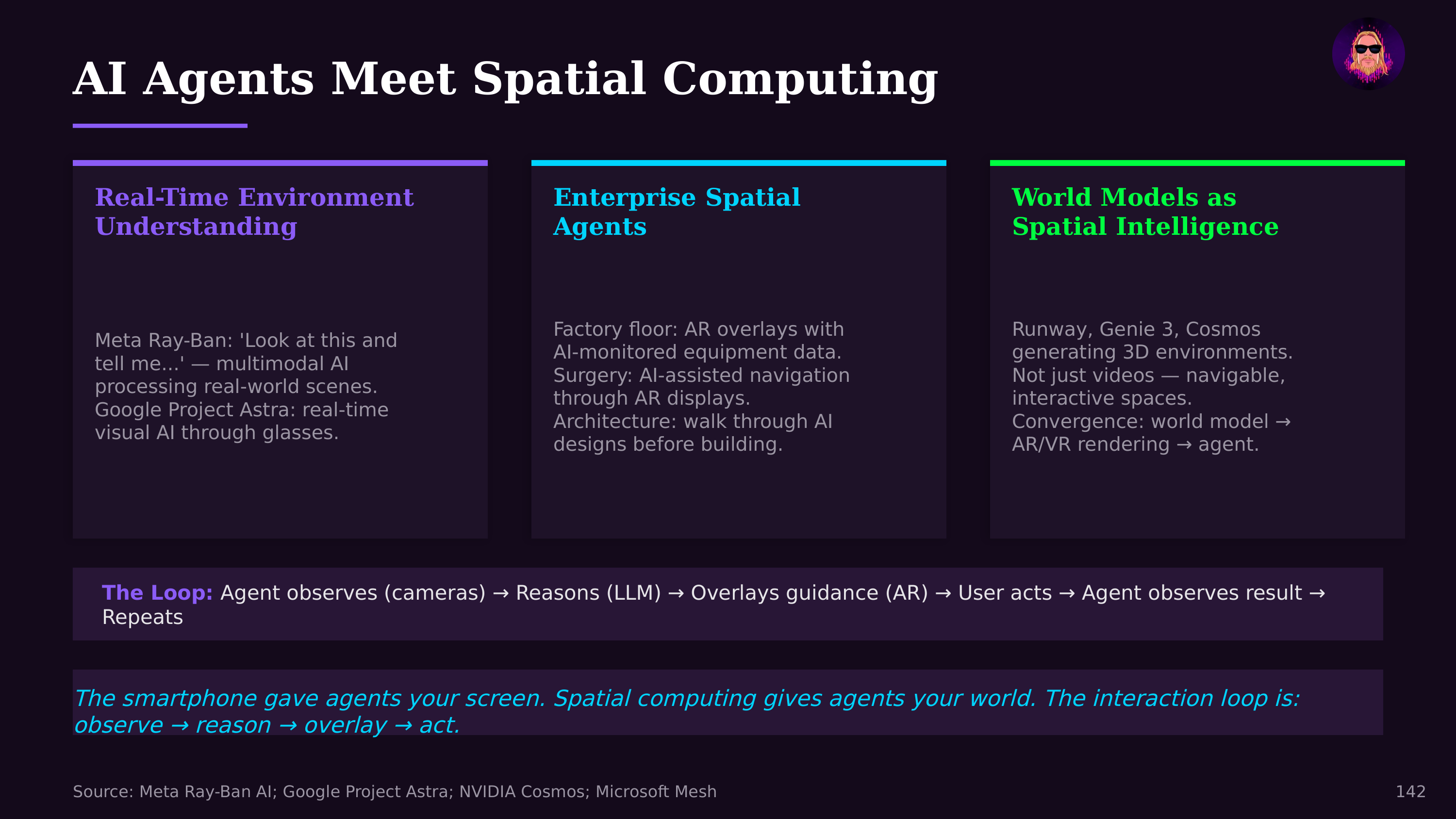
The core capabilities include: Scene understanding — identifying what objects are in a space, where they are, and how they relate to each other ("that's a table with a coffee cup on it near a window"). Semantic mapping — building a 3D map of an environment that includes not just geometry but meaning ("this is the kitchen, that's a doorway, the floor is walkable"). Object persistence — remembering where virtual objects were placed and maintaining their position across sessions. Physics inference — understanding that objects have weight, surfaces have friction, and a virtual ball placed on a real table should roll if the table tilts. These capabilities transform AR from "overlaying graphics on camera feed" to "intelligently integrating digital content into physical reality."
The 2025-2026 breakthroughs are driven by foundation models for 3D. Just as language models learned to understand text and vision models learned to understand images, spatial foundation models are learning to understand 3D environments. Meta's SceneScript and similar systems can generate 3D scene representations from sensor data. Apple's Vision Pro uses spatial AI for environment understanding, hand tracking, and eye tracking simultaneously. Google's spatial AI work enables geospatial understanding at global scale. The combination of Gaussian splatting and NeRF techniques with AI scene understanding is enabling real-time 3D reconstruction that was impossible two years ago.
For the metaverse and virtual worlds, spatial AI is the missing piece. Virtual worlds that exist only in digital space don't need spatial AI. But the mixed reality vision — where digital and physical reality merge seamlessly — requires AI that deeply understands the physical environment. A virtual character that can sit on your real couch, a navigation overlay that understands your building's layout, a remote collaborator whose avatar interacts naturally with your physical workspace — all of these require spatial AI. The Rainbows End vision of AR overlays that transform physical spaces into personalized digital environments is fundamentally a spatial AI problem.
The applications extend well beyond consumer AR. Autonomous vehicles use spatial AI to understand road environments. Robots use it to navigate and manipulate objects in unstructured environments. Digital twins of factories, cities, and buildings rely on spatial AI to keep virtual models synchronized with physical reality. Smart city infrastructure uses spatial AI for traffic management, urban planning, and emergency response. The same core technology — AI that understands 3D space — serves all of these applications.
Further Reading
- Spatial Computing — The hardware platform
- Augmented Reality — The primary consumer interface
- Gaussian Splatting — Key 3D reconstruction technique